

Why emotional connection sits at the apex of customer experience.
One visit to a new coffee shop has done more to make me feel valued than twelve months with my dentist.
That might seem an unlikely comparison. The services are different, as are the stakes. But both businesses depend on people choosing to return. And both have an opportunity, every time someone walks through the door, to build a relationship.
Only one has made me feel that it wants one.
Our neighbourhood high street offers a useful lesson in customer experience. Increasingly, its shops are occupied by service businesses: hairdressers, dentists, vets and coffee bars. A high street location provides visibility, easy access and convenience. Those are valuable advantages. But being convenient does not, by itself, create loyalty.
At RealService, we describe customer experience as a pyramid with three levels:
• Get the basics right.
• Make it easy to do business.
• Create a genuine and positive emotional connection.
These three principles build on one another. The foundations matter, but the apex is where customers begin to feel recognised, valued and connected.
My high street has reminded me just how much that matters.

Why I’m changing dentist
After twelve months, I have decided to move dental practices.
I have no complaints about the treatment I received. The practice is conveniently located. On the first two levels of the pyramid, there is much to be satisfied with.
Yet I have never developed any sense of connection with the place or its people.
The welcome at reception has consistently felt indifferent. The receptionist often appeared bored, giving me little sense that greeting patients was something they enjoyed or regarded as important.
Then there was the revolving cast of clinicians. I never seemed to see the same dentist or hygienist twice. Each visit felt like starting again.
Continuity matters, particularly in a service where confidence and trust are so personal. Familiarity allows a relationship to develop. Someone gets to know you, understands your concerns and remembers the conversation you had last time.
Of course, it is not always possible to see the same person. People move on, rotas change and appointments need to fit around busy lives. That makes a shared service culture even more important. A new face can still offer a familiar standard of care: a warm introduction, an understanding of your history and a clear sense that colleagues have handed things over properly.
Without either continuity or an evident shared culture, the experience feels fragmented. There may be a patient record, but there is little feeling of a relationship.
Reflecting on my decision to leave, it comes down entirely to that missing emotional connection. Nothing dramatic went wrong. There was simply nothing drawing me back.
A coffee shop that understands the assignment
Contrast that with the coffee bar that has just opened on the site of a failed restaurant.
By my count, it is probably the sixth coffee shop among roughly thirty shops in our small suburb. Competition from established local businesses and bigger operators is fierce. Another place selling coffee needs to give people a reason to choose it.
From the moment I walked in, this operator seemed to understand that.
The barista greeted me warmly. Once I was seated, the manager came over, introduced himself, asked my name and shook my hand. He thanked me for being one of their first customers and asked whether I needed anything else.
These were simple gestures. Together, they made a clear impression: someone was pleased I had come in.
In a single visit, the coffee shop created more connection than my dental practice had managed in twelve months.
That welcome gives me a reason to return. Whether it becomes loyalty will depend on what happens next: the quality of the coffee, the ease of the experience and whether the warmth survives the opening weeks.
But they have made an excellent start. They have recognised that a customer is someone to get to know.
What the property industry can learn
For property owners, managers and service partners, these everyday encounters contain some important lessons.
First impressions set expectations. A reception desk, a first viewing, a welcome email or a move-in conversation tells customers what kind of relationship to expect. Do they feel acknowledged? Is someone interested in them? Does the welcome inspire confidence? These moments deserve as much thought as the appearance of the space.
Consistency builds trust. Customers value familiar people, but they also need confidence that the experience will hold together when those people are absent. Good handovers, shared knowledge and consistent behaviour help a customer feel known across a whole team.
A service culture must extend beyond individual personalities. A welcoming receptionist or an exceptional building manager can make a powerful difference. Leaders need to create the conditions for that care to be evident throughout the organisation, including among contractors and service partners. Customers experience everyone as part of the same service.
Professional competence is a foundation. A well-maintained building, accurate billing and a prompt response to repairs are essential. Emotional connection adds something further: confidence that someone understands the customer’s circumstances, takes ownership and cares about the outcome.
The risk is assuming that customers who have no complaints must feel loyal. My dentist could reasonably have concluded that everything was fine. The treatment was satisfactory and I kept attending appointments. Yet the relationship was going nowhere.
Property businesses should ask themselves the same question: are customers staying because they feel valued, or because moving is inconvenient?
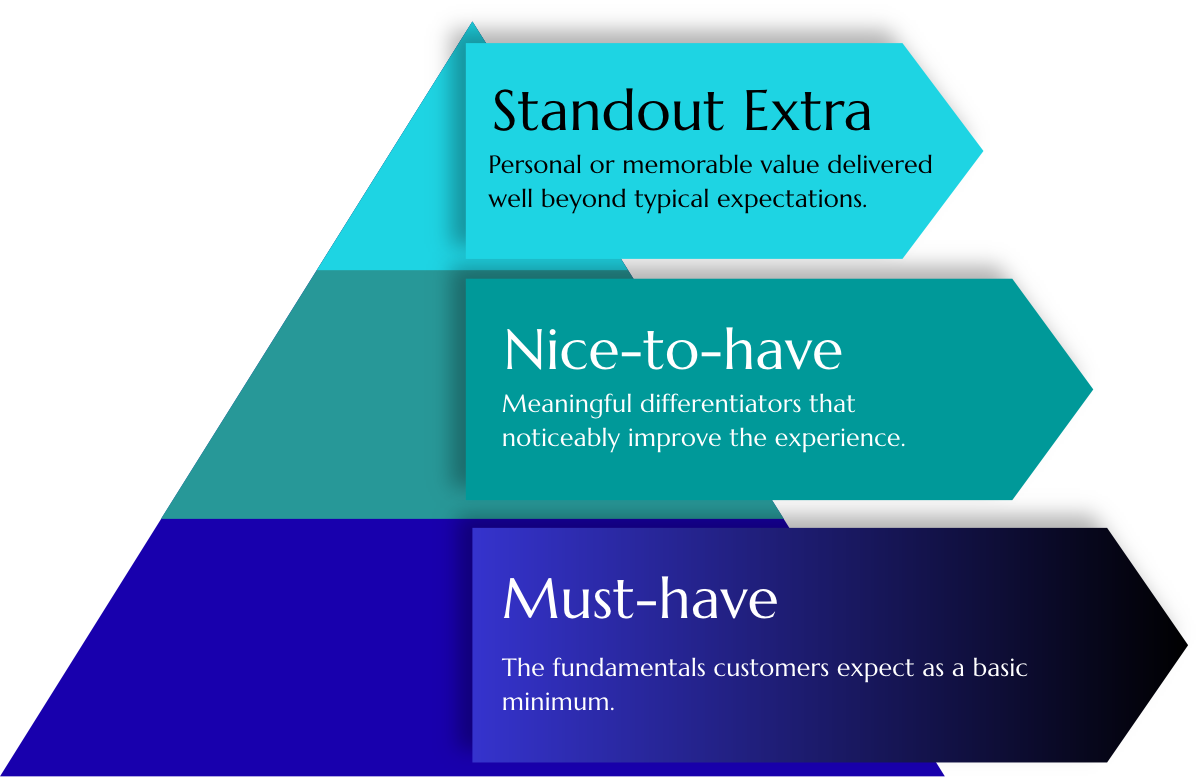
Reaching the top of the pyramid
Emotional connection does not require grand gestures. It often begins with a greeting, an introduction, a remembered detail or a thoughtful follow-up. Its strength comes from those actions being genuine and consistent.
The coffee shop has understood this from day one. My dental practice missed it over an entire year.
For the property industry, the lesson is clear. Get the basics right. Make life easy. Then give people a reason to feel that they matter.
That is how good service becomes a relationship—and how a relationship earns loyalty.
If you’d like to explore how you can maximise loyalty and customer retention by creating stronger emotional connections, get in touch with RealService. We’d love to help you put these principles into practice.
