
Author: Chenai Gondo
A note on terminology: Throughout this article, I've used the term tenant rather than our preferred term, customer, to remain consistent with GRESB's terminology. At RealService, we refer to the people and organisations occupying buildings as customers.
GRESB has published its new 2028 Real Estate Standard, and there's some very welcome news for those of us working in customer experience.
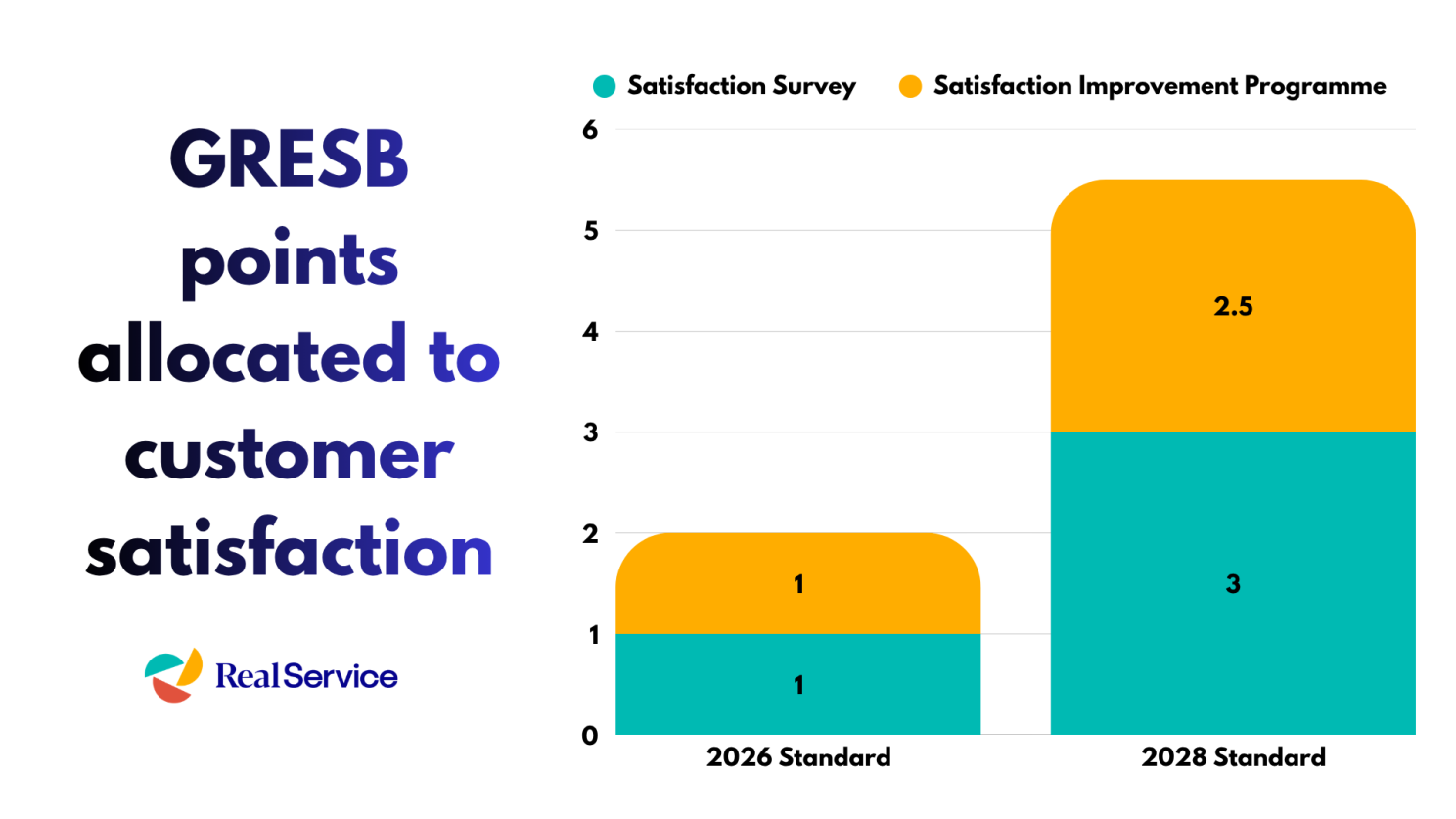
The weighting of tenant satisfaction surveys is tripling, while programmes to improve tenant . satisfaction will be worth two and a half times as many points as before.
Combined, that's a 175% increase in the weighting of tenant satisfaction measurement and improvement.
So, what's changing, and what does it mean for property owners and managers?
1. The value of tenant satisfaction surveys is tripling
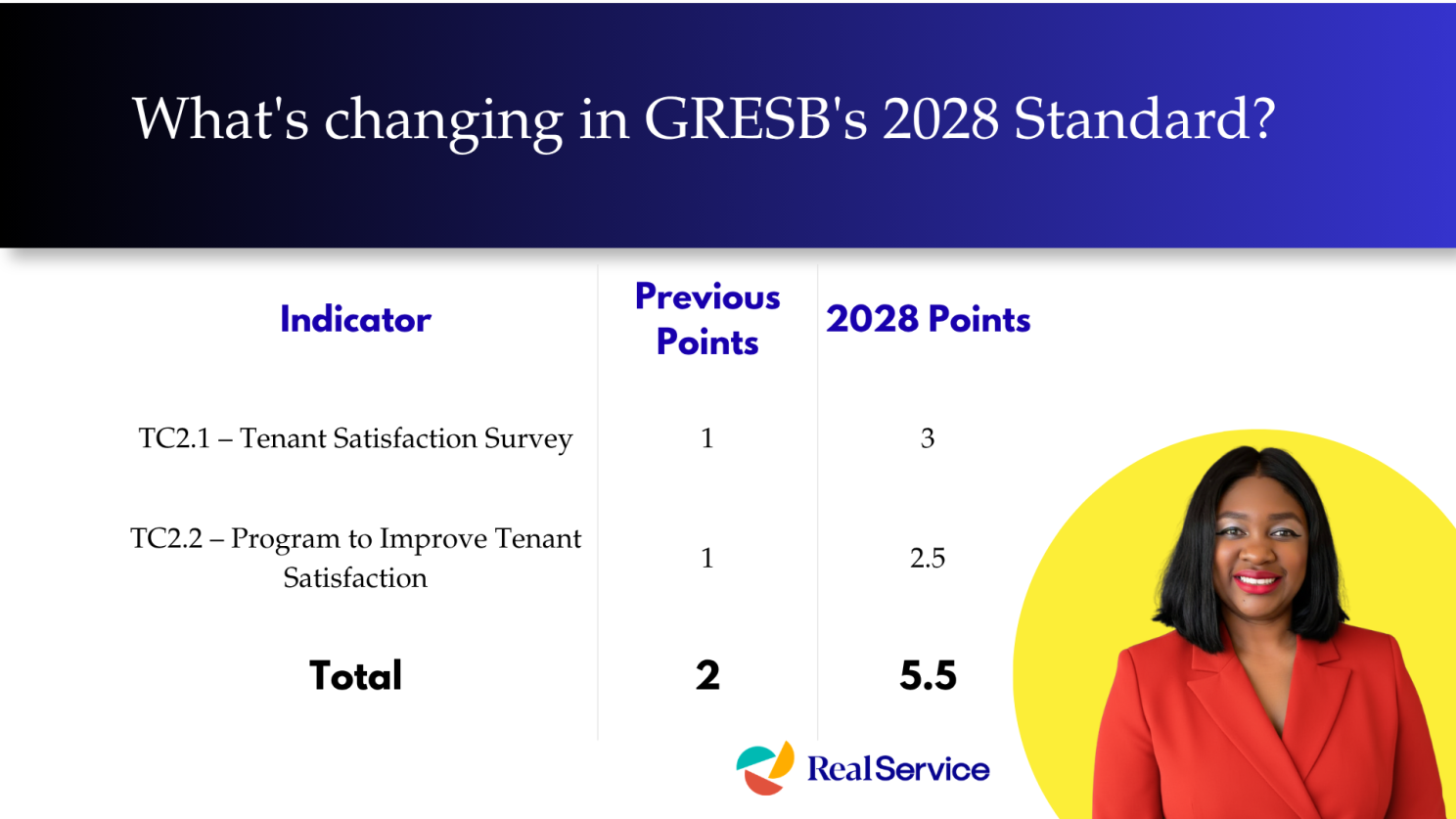
Under the new Standard, TC2.1 – Tenant Satisfaction Survey increases from 1 point to 3 points.
That's three times the previous weighting, making tenant satisfaction surveys significantly more important to an organisation's overall GRESB score.
2. Acting on tenant feedback is now worth 2.5 times as much
TC2.2 – Program to Improve Tenant Satisfaction increases from 1 point to 2.5 points.
GRESB is placing greater emphasis not just on collecting customer feedback, but on having a programme to act on it. This might include improvements to communication, service delivery, property management standards or staff training.
3. Together, that's a 175% increase in the points available for tenant satisfaction
Previously, the two indicators were worth a combined 2 points. Under the 2028 Standard, they'll be worth 5.5 points out of 100, a 175% increase.
For property owners and managers participating in GRESB, customer satisfaction measurement and improvement will therefore carry substantially more weight in the overall assessment.
4. Independent surveys still receive more points
One detail property owners should pay attention to is how GRESB treats independently conducted surveys.
Under GRESB's existing scoring methodology, surveys conducted by an independent third party receive full credit for the survey-administration component (3/3), compared with 2/3 for internally conducted surveys - that's 50% more credit within this component.
GRESB recognises independent third parties responsible for developing and administering surveys, including managing responses and analysing results. External managing agents can also qualify. Simply using an external survey platform doesn't necessarily make a survey independent.
With the overall weighting of TC2.1 increasing from 1 to 3 points, understanding how your surveys are administered becomes particularly important.
5. Using survey software doesn't make your survey independent
GRESB recognises independent third parties responsible for developing and administering surveys, including managing responses and analysing results.
A landlord using an external survey platform to conduct its own research doesn't automatically qualify as using an independent third party. However, an external property management company can qualify under GRESB's guidance.
Property owners should review how their surveys are administered and ensure they can demonstrate the role of any independent provider.
6. You don't need a perfect tenant satisfaction score to earn the points
The new Standard doesn't require organisations to achieve a particular NPS or overall satisfaction score to earn points under these indicators.
GRESB continues to reward the processes used to measure tenant satisfaction and the programmes established to improve it, rather than directly scoring the satisfaction results themselves.
When do the changes take effect?
The changes take effect in the 2028 GRESB assessment, using 2027 data.
For property owners and managers participating in GRESB, now is a good time to review existing survey arrangements, consider whether they're maximising the available scoring credit and ensure that customer feedback is being translated into meaningful improvement programmes.
Ready to launch your next GRESB Survey?
At RealService, we've spent more than 27 years helping the real estate industry understand and improve customer experience. We independently gather customer insight, benchmark performance through our RealService Customer Experience Index (RS CX Index) and help property owners and managers turn their findings into practical improvements. In other words, we help clients with both sides of the GRESB tenant satisfaction equation: independently measuring customer satisfaction and improving it.
We're pleased to see GRESB giving customer experience greater recognition within its assessment framework.
If you're reviewing your tenant satisfaction programme ahead of the 2028 assessment, get in touch with RealService to find out how we can help: https://www.real-service.com/
Source: GRESB 2028 Real Estate Standard, published 4 November 2026.
About the Author
For more insights like this, follow me Chenai Gondo, PhD and subscribe to my newsletter. I am the CEO of RealService and Experience Makers. We help real estate owners and operators understand and improve how their spaces are being experienced by people. I write a weekly newsletter about real estate, entrepreneurship, business, human behaviour and occasionally, about my wigs.
Topics Covered in this Article
GRESB 2028 Real Estate Standard, GRESB 2028 changes, GRESB tenant satisfaction surveys, GRESB tenant satisfaction scoring, GRESB TC2.1, GRESB TC2.2, GRESB tenant satisfaction requirements, GRESB independent third-party surveys, GRESB survey independence requirements, GRESB tenant satisfaction improvement programmes, GRESB 2028 assessment, GRESB ESG reporting, GRESB points allocation, GRESB scoring methodology, tenant satisfaction surveys, independent tenant satisfaction surveys, customer satisfaction surveys in real estate, real estate customer experience, commercial real estate customer satisfaction, occupier satisfaction surveys, tenant experience measurement, property management customer satisfaction, landlord tenant satisfaction, tenant satisfaction benchmarking, customer experience benchmarking, Net Promoter Score in real estate, real estate NPS benchmarking, tenant feedback programmes, tenant engagement surveys, tenant retention, customer experience improvement, ESG social performance metrics, real estate sustainability reporting, RealService, RealService Customer Experience Index, RS CX Index
