
What a Hospital Visit Taught Me About Customer Experience - by Howard Morgan

Part 1: From being processed to being understood
I didn’t expect to get a lesson in customer experience from a hospital.
After the usual clinical check-in – forms, ID, the slightly anxious wait – something different happened. A smiling lady appeared, introduced herself by name, took my trolley bag, and walked me to my hospital bed. On the way she checked how I was feeling, pointed out where I could get a glass of water, and asked if I had any worries about the procedure.
It felt more like arriving at a top hotel than a hospital. I immediately felt:
Welcomed – someone was expecting me, personally
Valued – I wasn’t just “next on the list”
Reassured – she knew what would happen to me and quietly de-dramatised it
At home – I knew where things were and who to ask
Only later did I discover she was a volunteer, and that this meet-and-greet role was relatively new. That really stopped me in my tracks. Could it really be that hospital management were unable to put a price on customer experience and therefore couldn’t justify a salaried post?
Hospitals are full of processes, protocols and pathways. Yet this small, human touch transformed the whole experience. It made me wonder: In property – commercial and residential – we obsess about processes and compliance, but how often do we deliberately design for the emotional journey of our customers?
Could we in real estate, like the hospital, undervalue the role that customer experience plays in delivering value?
From process map to emotional map
Most organisations can produce a process map that looks something like:
Arrive → Check in → Wait → Use the service → Leave
In a hospital, the stages might be:
Referral, admission, pre-op, procedure, recovery, discharge
In a building, it might be:
Arrival at the estate, reception, moving through common parts, using the space, accessing services, leaving.
What the hospital did so well was overlay an emotional journey on top of the operational one. That volunteer wasn’t “just being nice”. She was performing a critical front-stage role, bridging the gap between clinical process and human emotion.
Now imagine if we did the same in our commercial and residential buildings.
Journey mapping for buildings – and why it matters
RealService is a specialist customer experience consultancy for the property industry. Our entire focus is helping landlords, investors and managers put occupiers at the heart of decision-making – using customer insight surveys, journey mapping, benchmarking and training.
For the office sector, the BCO has drawn heavily on this kind of thinking. Its “Office Service Standards and Customer Experience” best practice guide (devised by RealService) talks about a needed revolution: moving from “space as a commodity” to “space as a service” and provides scorecards and checklists to measure how well a building performs from owner, manager and occupier perspectives.
More recently, the BCO’s “Towards Experience Utopia” report 2024 – researched and authored by RealService – offers a state-of-the-nation view of hybrid work and sets out best practice for designing ideal working environments, with a strong focus on treating staff like customers and prioritising experience.
A typical building journey – whether office, mixed-use or residential – might look like:
Pre-arrival – invitation, directions, access details, move-in information
Arrival at the street – wayfinding, first impressions, lighting, perceived safety
Threshold / reception / lobby – security, welcome, check-in / fob collection
Movement through the building – lifts, corridors, signage, cleanliness
Time in the space – comfort, noise, maintenance, community, services
Departure & follow-up – exit, communication, renewals, feedback
For each stage, there are two design challenges:
Process needs – what has to happen for the building to operate and remain compliant?
Emotional needs – how do we want people to feel?
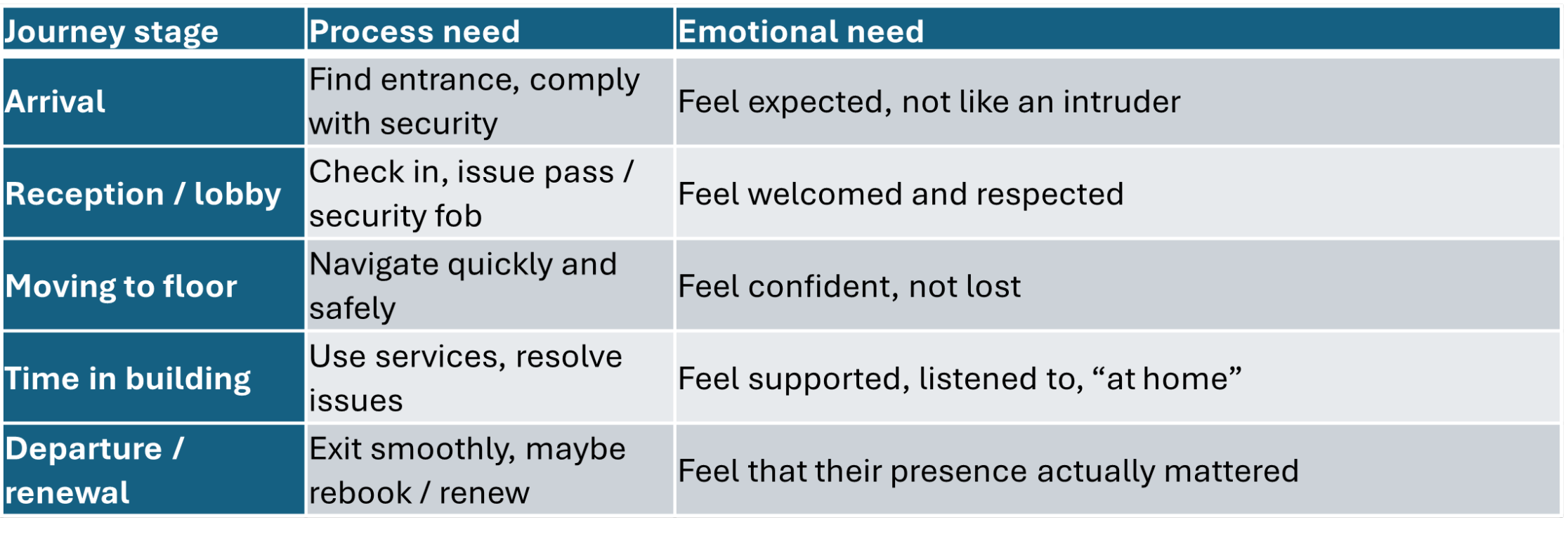
Office building journey - from process to emotional need
That hospital volunteer is the embodiment of an arrival / reception intervention. In property, the equivalent might be a concierge, a security officer with a hospitality mindset, or a community / resident manager – someone whose job is to own the welcome.
Residential: where it matters even more?
Everything above applies to offices and commercial buildings – but it arguably matters even more in residential.
Why?
Home is deeply emotional Offices support productivity. Homes support identity, safety and belonging. A bad office experience is frustrating; a bad home experience can feel personal. Residents need to feel safe and secure, known and respected, listened to when things go wrong and proud to invite friends and family.
The journey is 24/7, not 9-to-5 Office users may pass through a building a few days a week. Residents live with decisions all the time: late-night noise, lift reliability, parcel handling, cleaning standards, antisocial behaviour, repairs. The touchpoints are constant, and so are the emotional highs and lows.
Retention and reputation are everything In Build-to-Rent and managed residential portfolios, business models rely on renewals and referrals. The emotional journey isn’t fluff, it’s core product.
Residents can be more vulnerable than office users People may be going through big life changes: forming relationships, separating, having children, downsizing, dealing with illness or financial stress. The way staff handle arrears or repairs can have a huge emotional impact.
In a residential context, the “volunteer-style” role might look like a Resident Host, on-site manager, or concierge team whose mindset is welcoming people home, not just handing out parcels and keys.
What this looks like in practice: a London case study
This isn’t just theory.
RealService is currently working with a major London property owner who publicly emphasises a customer-focused, community-oriented approach, highlighting the importance of strong relationships with occupiers and local stakeholders.
Over the past 8 weeks we've introduced these ideas and equipped over 100 asset managers, property managers and FM's with the skills to implement customer journey mapping in their business.
Why work with RealService
RealService specialises in helping clients to turn occupier feedback into actionable insight that drives satisfaction, retention and asset value growth – which is exactly why leading owners trust us with their customer experience research.
Alongside this research work, RealService designs training and customer-journey-mapping programmes for property owners and managers across the market. These programmes typically bring together:
In-house asset and property managers
Outsourced managing agents and FM providers
Front-of-house, security, cleaning and maintenance teams
The aim is simple: equip everyone involved in running a building or estate with the skills and tools to see things through the customer’s eyes and redesign key journeys accordingly.
Here is some typical delegate feedback from these sessions:
“I’ve worked on this estate for years but this is the first time I’ve really seen it through the occupier’s or resident’s eyes.”
“Journey mapping helped us spot clunky hand-offs between our team and our managing agent that we’d never noticed.”
“I feel more confident dealing with complaints – I understand the emotional journey as well as the technical fix.”
“Having security, cleaning and property managers in the same room made it clear that we all own the welcome.”
For owners, the benefits go way beyond “a nice training day”. RealService backs this up with data – for example, through occupier satisfaction benchmarks and CX indices that show how improvements in experience link to loyalty, reputation and long-term income.
In other words, they’re doing in their buildings what that hospital did for me: deliberately designing the emotional journey – and backing it up with structure, skills and evidence, not just good intentions.
Lessons for the property industry
Design the welcome – don’t leave it to chance
Make emotional outcomes explicit in service level agreements
Everyone can be a host – not just the reception team
My hospital visit reminded me that people remember how you made them feel long after they’ve forgotten the paperwork and processes. In property – commercial, mixed-use and residential – we have the same opportunity.
If we get that right, maybe one day an occupier or resident will leave your building and say:
“Yes, the space is great – but what really strikes me is how they look after me from the moment I arrive.”
For more information about our services please message me on lInkedin or email info@real-service.co.uk
Look out for Part 2 coming soon : Finding a new home for your business – and what happens after you move in
