Ten Takeaways from IPF’s UK Property Outlook for 2026
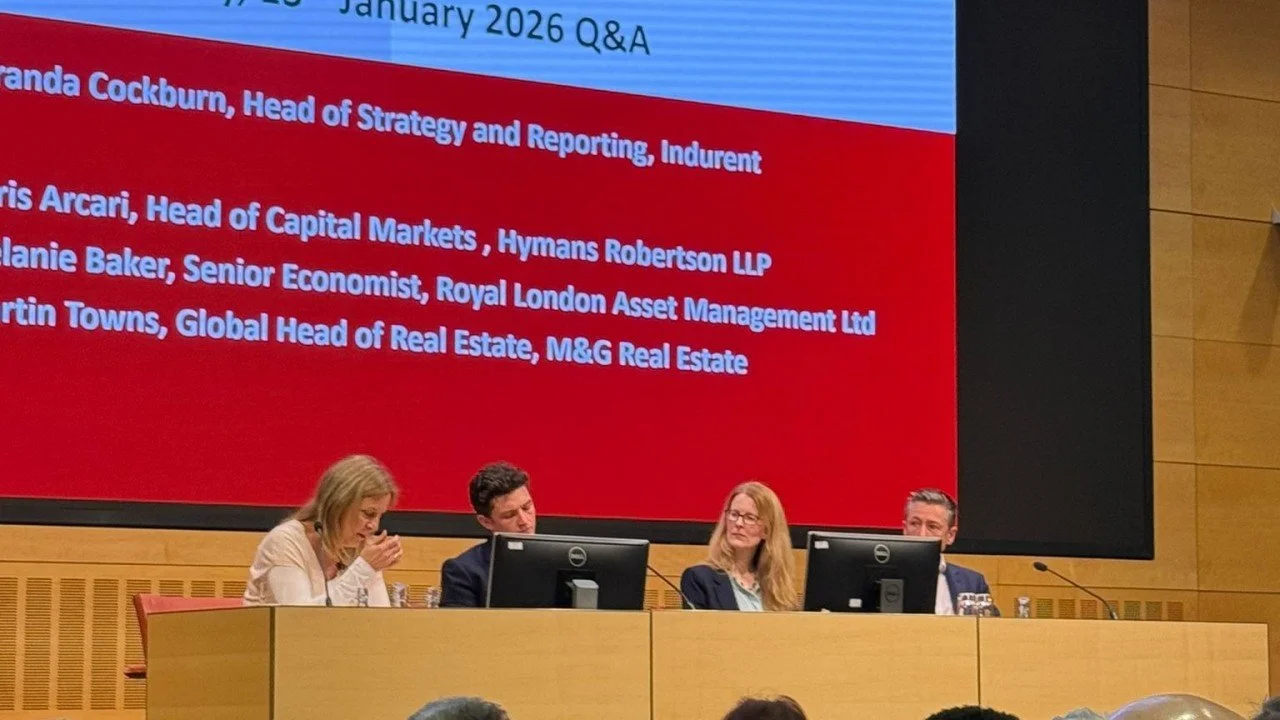
This morning I attended a UK property outlook seminar co-hosted by the Investment Property Forum and Society of Property Researchers , where I’m a member - a room full of people who actually read footnotes and argue about data for fun.
The speakers were: Melanie Baker, Senior Economist at Royal London Asset Management, Chris Arcari , Head of Capital Markets at Hymans Robertson LLP and Martin Towns , Head of Global Real Estate at M&G Real Estate. The panel was expertly moderated by Miranda Cockburn , Head of Strategy and Reporting at Indurent Management Limited
I went in with a fairly loaded mental backdrop. I’d recently read an Economist article questioning whether we truly have an “affordability crisis” or whether we’re actually living with a bundle of unresolved contradictions we don’t like admitting to. Goods, after all, have never been cheaper. Most of us have completely forgotten how long our parents saved for something like a television. Yet services have become eye-wateringly expensive. We want to be paid more, while having access to affordable carers, cleaners, builders, and hospitality workers. We want our homes to rise in value when we own them but to be cheap when our children want to buy.
All of these things cannot be true at once. But we keep demanding them anyway.
Layer on top my heavy consumption of US real estate news (thank you, New York Times and assorted newsletters): What happens if Trump bans institutional investment in single-family housing? What if political crackdowns on landlords spread? Do we see a flight to “safe, dull, rule-of-law” markets like the UK?
Interestingly, little of this really came up in the form I expected. Instead, the conversation stayed grounded. I did learn a lot - and here are the ten takeaways that actually mattered.
Ten Forward-Looking Takeaways on the Outlook for UK Property in 2026
1. 2026 will remain an income-first market — capital growth stays secondary
The clear message looking ahead is that income will continue to do the heavy lifting. With income already accounting for around 80% of total returns, that structure is unlikely to change materially by 2026.
Capital growth will remain muted and selective, because it ultimately relies on stronger underlying economic growth — which no one credibly sees accelerating fast enough.
If you’re underwriting for capital-led upside, you’re probably going to be disappointed.
2. Expect total returns to hover around “good enough,” not spectacular
The near-term expectation of c.7% total return sets the tone for 2026 as well: steady, unexciting, but investable.
This is a market pricing realism, not optimism. And frankly, after the last few years, that’s not a bad thing.
3. Falling interest rates will matter more for sentiment than for fundamentals
Rate reductions are expected to:
Unlock transaction activity
Improve sentiment toward UK real estate and UK REITs
Help narrow deep discounts to NAV
By 2026, the biggest impact of lower rates won’t be repricing assets overnight — it will be restoring market confidence and liquidity.
Deals need belief as much as maths.
4. UK REITs are set up for a sentiment rebound — not a fundamental reset
Operationally, many UK REITs performed well last year - a note was made on retail and income-secure sectors like supermarkets.
Looking ahead to 2026:
Rate cuts should support REIT sentiment
Discounts to NAV look increasingly unjustified if income remains robust
A re-rating is possible, but it will be uneven
This is not a blanket recovery story — it’s asset- and balance-sheet-specific.
5. The occupational market should remain resilient into 2026
The expectation is for a robust occupational market to persist:
Demand hasn’t fallen off a cliff
Labour market softness hasn’t translated into mass space abandonment
Rental growth continues in specific pockets
This matters more than macro noise. Real estate doesn’t collapse because GDP growth is mediocre — it collapses when tenants disappear. That’s not the base case.
6. Offices are back — cautiously, selectively, and unevenly
One of the biggest shifts looking toward 2026 is the return of office investment:
Strong rental growth in the best assets
Capital values still relatively low
Increasing investor interest after a dramatic sentiment flip in the last 12 months
This will not be a broad office recovery. It will be polarised, with quality, location, and functionality doing all the work.
7. Retail continues its slow rehabilitation — even shopping centres
By 2026, retail is expected to be:
Increasingly viewed as a value play
Investable again, including dominant shopping centres
Positioned as a physical complement to online, not its victim
This is less about nostalgia for bricks-and-mortar and more about realism: people still shop in the real world.
8. UK property will remain “cheap” — and that’s both a strength and a weakness
The UK continues to lag markets like France, Germany, and Japan post-Brexit and post-Covid.
Looking ahead:
The UK remains a relative value opportunity
Foreign capital will continue to play a major role
But investors increasingly want proof of a functioning domestic capital base
By 2026, pressure will grow for defined contribution pension capital to start allocating meaningfully — without it, the market remains structurally exposed.
9. Capital flows may tilt toward Europe — but risks remain elevated
There are reasons for optimism:
US allocations are already flowing toward Europe
European self-reliance could support growth
Debt finance is becoming cheaper
But this sits alongside:
Elevated geopolitical risk
Lack of broader economic dynamism
Capital stuck in closed-ended fund structures
Long-term rates that still feel optimistically high
In short: tailwinds and headwinds arrive together.
10. By 2026, the real consolidation will be impossible to ignore
Perhaps the most inevitable outlook point:
Large managers will continue to dominate
Small, high-conviction specialists will survive
Mid-sized, undifferentiated managers and funds will be forced to merge, shrink, or close
Expect consolidation across:
Private funds
Listed vehicles
Asset and fund management platforms
The market is no longer big enough, or forgiving enough, for strategies that sit awkwardly in the middle.
A final thought - and where this lands for us
The outlook for 2026 isn’t about growth fixing everything. It was about accepting constraints on capital, on labour, on sentiment, and performing anyway.
When income does the heavy lifting, when tenants have choices, and when investors stop rewarding vague narratives, the differentiator becomes brutally simple: how well buildings actually work for the people using them.
That’s why operational performance matters more than ever and why the work we do at RealService sits at the heart of this next phase. We helping clients answer those questions operationally - not in theory, but in buildings that have to work, every day.
If this resonates, I’m always open to a conversation, or a disagreement, in the comments or over a coffee.
For more insights like this, follow me Chenai Gondo, PhD